
What Are You Really Building? Why Your Business Needs Meaning, Health and Strategy
You are working hard, learning new skills, attending events and building your business. Your diary is full, and you are making progress.
But have you considered what all that effort is building towards?
Perhaps you want financial security, more freedom, time with your family or the satisfaction of making a difference.
Yet somewhere between running your business and managing everything else in your life, those original ambitions can become surprisingly easy to overlook.
Your business will only ever be as healthy as you. And surely, the purpose of building a successful business includes creating a life you actually want to live.
What does success mean beyond making money?
Revenue matters. Without it, your business cannot survive, let alone grow.
But revenue alone cannot tell you whether you are building the business, or the life, you originally wanted.
In this week's Routine Reset podcast, I explore legacy and meaning, the final topic in our first series of 36 episodes covering the T.E.M.P.L.E. Method™.
Legacy might sound like something to consider towards the end of your career. I believe it deserves attention much earlier.
What do you want your work to stand for? Who do you want to help? What difference would you like your business to make?
Research by organisational psychologist Adam Grant found that helping people understand the positive impact of their work improved performance in several workplace experiments.¹
The research does not establish that every purpose-driven business will be more profitable. It does suggest that recognising the significance of your work can influence how you approach it.
Meaning can give your daily efforts a direction beyond the next invoice.
Are you building a business that supports your life?
This question becomes particularly relevant in later-life entrepreneurship.
You may be building a business while supporting children, helping ageing parents, managing hormonal changes or adjusting to changing energy levels.
And you may be doing several of those things simultaneously.
Your business still needs customers, consistent delivery and sound financial decisions.
It is easy to become so occupied with meeting those demands that your personal needs move further down the priority list.
You might recognise the pattern without considering yourself overwhelmed.
You miss a walk because another task needs finishing. You postpone bedtime to catch up. You attend another training session while the actions from the previous one remain unfinished.
Each decision seems reasonable.
But collectively, are they helping you build the life you want?
Research into self-determination theory identifies autonomy, competence and relatedness as important psychological needs associated with motivation and wellbeing.²
That matters when your ambition includes independence, meaningful work and time for important relationships.
Your business should have room for those ambitions, too.
Why is personal wellbeing part of your business strategy?
Business advice often focuses on systems, processes, delegation and growth.
These are essential.
However, somebody still needs the energy, concentration and judgement to implement those systems.
If you regularly work beyond your capacity, struggle to think clearly or have little opportunity to recover, even a well-designed business strategy becomes harder to execute consistently.
This is where personal wellbeing deserves a place in business planning.
Within my T.E.M.P.L.E. Method™, I consider Time Utilisation alongside Intellectual Health, Mental Resilience, Physical Vitality, Spiritual Health and Emotional Intelligence.
Together, these areas influence how you operate personally and professionally.
For example, protecting time for rest may improve your ability to concentrate. Reviewing your priorities can reduce unnecessary activity. Developing emotional awareness may help you respond more thoughtfully during difficult conversations.
These are practical considerations for business performance.
And if your business demands remain excessive, those demands need addressing as well.
Sustainable success requires attention to both your business structure and your personal capacity.
What does trusting yourself have to do with entrepreneurship?
Last week, a meditation centred on trusting life prompted some unexpected reflections.
One affirmation particularly challenged me:
I trust that I am where I am meant to be.
As an ambitious entrepreneur, I naturally want to be further ahead.
There are customers to attract, opportunities to pursue and financial goals to achieve.
But reflecting on that statement helped me recognise how much I have already developed, and how previous experiences have influenced the direction of my business.
I also reflected on trusting myself, accepting support and believing in my vision.
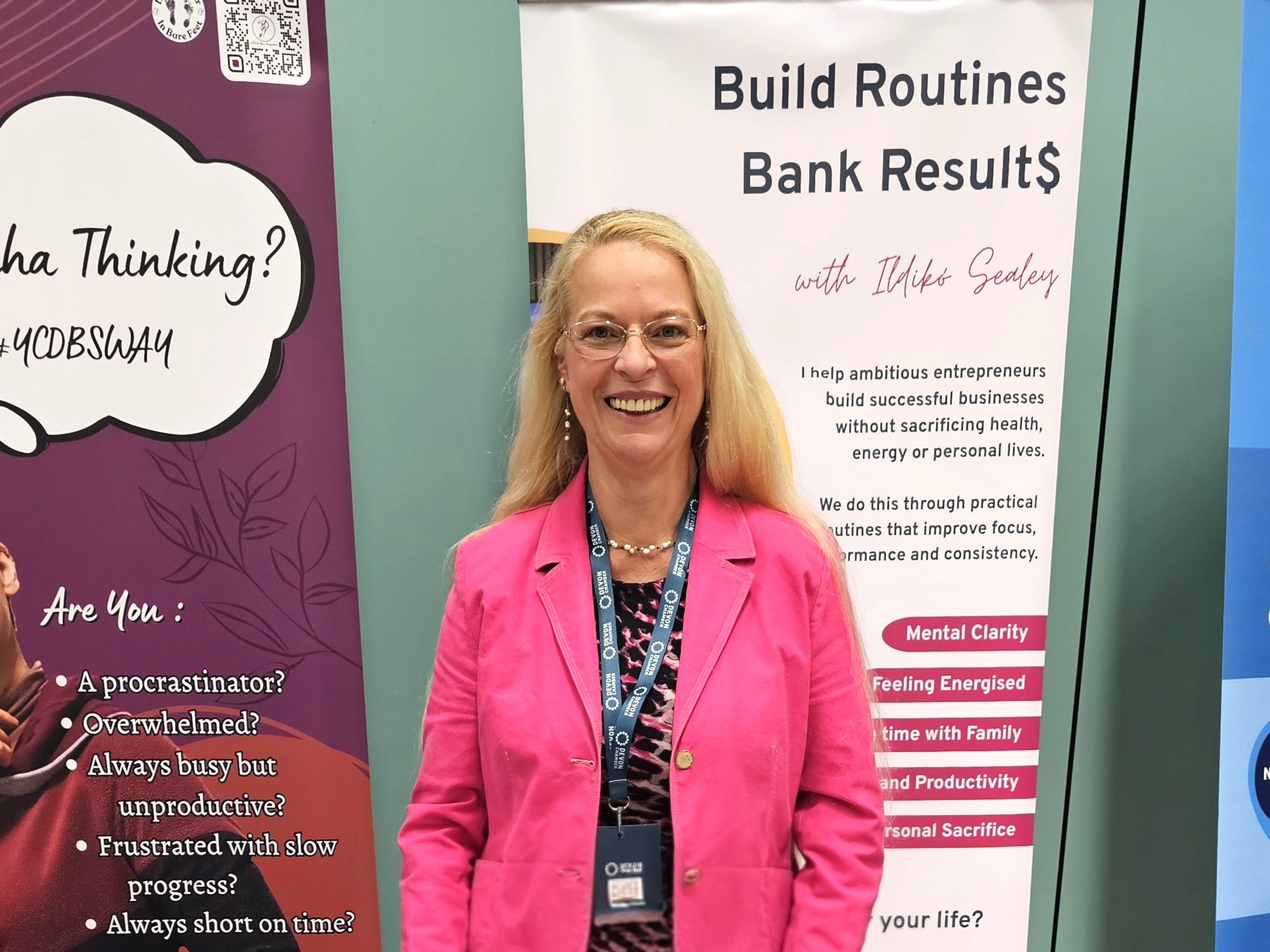
That same week, I exhibited at my first Devon Business Show.
I met new people, introduced my work and saw further evidence that conversations about personal wellbeing and business performance resonate with business owners.
Later, I created a vision and action board.
Seeing my ambitions brought together visually was unexpectedly emotional. It reminded me why I am building Routine Revolution in the first place.
I want to help entrepreneurs create healthier lives while improving their business performance.
That longer-term purpose influences the decisions I make today.
Do you need another coach, mentor or a clearer strategy?
There is certainly no shortage of advice available to entrepreneurs.
You can join programmes, attend webinars, follow experts and collect more information than you could realistically implement.
Coaches can help you explore your thinking. Mentors can share experience and perspective. Both can be valuable.
But what happens when you already understand that something needs improving and still cannot turn that understanding into consistent action?
You may need a more structured approach.
This is where my role as a Routine and Performance Strategist comes in.
I combine personalised assessment, practical recommendations and a structured methodology to help you identify how your current operating patterns affect your performance.
The intention is to connect what you learn with changes you can realistically make.
Research on goal-setting has established the value of clear, specific goals, while also recognising that performance depends on factors such as commitment, ability and feedback.³
Knowing what you want matters. Having a workable process for moving towards it matters too.
What will your business stand for in twenty years?
You do not need a grand legacy statement.
Start with three questions:
- What do I want my business to make possible in my life?
- What difference do I want my work to make for other people?
- Does the way I currently operate support those ambitions?
Your answers may reveal opportunities to reconsider your priorities, routines or approach to business growth.
You can begin making those adjustments now, while you are still building.
If you are unsure where to start, my free Hidden Bottleneck Quiz can help you identify an operating pattern that may be limiting your focus, energy or performance.
Build something that matters, including a life you enjoy living.
Remember, a healthier you makes a wealthier you.
References
- Grant, A. M. (2008). The Significance of Task Significance: Job Performance Effects, Relational Mechanisms, and Boundary Conditions. Journal of Applied Psychology, 93(1), 108–124. https://doi.org/10.1037/0021-9010.93.1.108
- Ryan, R. M., & Deci, E. L. (2000). Self-Determination Theory and the Facilitation of Intrinsic Motivation, Social Development, and Well-Being. American Psychologist, 55(1), 68–78. https://doi.org/10.1037/0003-066X.55.1.68
- Locke, E. A., & Latham, G. P. (2002). Building a Practically Useful Theory of Goal Setting and Task Motivation: A 35-Year Odyssey. American Psychologist, 57(9), 705–717. https://doi.org/10.1037/0003-066X.57.9.705